
Free Sensory Profile Template (Download)

If you’ve ever thought, “Why does this bother them so much?” or “Why do they seek out that sensation constantly?”—you’re already asking the right questions.
Sensory processing plays a huge role in how neurodivergent individuals experience the world. And when we better understand those sensory needs, we can prevent meltdowns, support regulation, and create environments where they actually thrive—not just cope.
That’s where a sensory profile comes in.
What Is a Sensory Profile?
A sensory profile is a simple tool used to identify how someone:
Responds to sensory input (sounds, textures, movement, etc.)
Seeks or avoids certain sensations
Regulates their body and emotions
Instead of guessing what’s “wrong,” it helps you understand what’s happening.
Why This Matters
When sensory needs go unmet, you might see:
Meltdowns or shutdowns
Avoidance behaviors
Difficulty focusing
Increased anxiety
But when sensory needs are understood and supported:
Regulation improves
Communication increases
Challenging behaviors often decrease naturally
This isn’t about “fixing” behaviors—it’s about meeting needs.
What’s Included in This Free Template
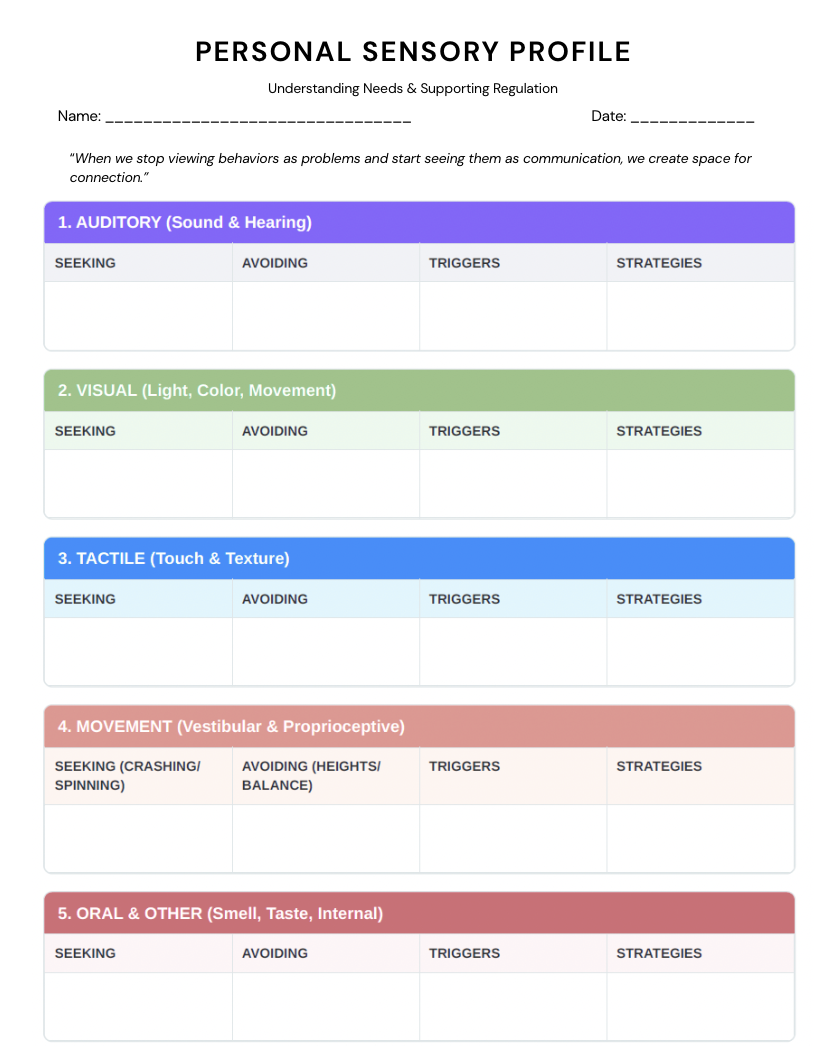
This sensory profile is designed to be simple, practical, and actually usable for parents, caregivers, and clinicians.
Sections Included:
Auditory (sound sensitivity/seeking)
Visual (light, movement, clutter)
Tactile (touch, textures, clothing)
Oral/Sensory (food, chewing, mouthing, licking, biting)
Vestibular (movement, swinging, spinning, balance,)
Proprioceptive (body awareness, running, squeezes/pressure, crashing)
Each section helps you identify:
Sensory seeking behaviors (I really like this and want to have access to it as much as possible)
Sensory avoidant behaviors (I really don’t like this and will try to avoid this or pull away if I come in contact with it)
Possible triggers (If this happens around me, it could make things worse and I may become very quickly overstimulated/feel out of control)
Helpful supports/strategies (What I need in the moments of overstimulation to help calm/reset by body or what I need proactively to keep from getting to that point).
How to Use It
Observe, don’t assume
Pay attention to patterns over time rather than one-off behaviors.Fill it out gradually
You don’t need to complete it in one sitting—real insight comes from consistency.Look for patterns
Are meltdowns happening in loud places? During transitions? With certain textures?Use it to guide support
Once you identify needs, you can:Add sensory breaks
Modify environments
Teach coping strategies
Example
Instead of: “They’re acting out at the grocery store”
You might discover: “They’re overwhelmed by noise + visual input + unpredictability”
That shift changes everything.
📥 Download Your Free Sensory Profile
Use this template to better understand sensory needs and start making meaningful, supportive changes.
[Download the Sensory Profile Template Below]
If you’ve ever thought, “Why does this bother them so much?” or “Why do they seek out that sensation constantly?”—you’re already asking the right questions.
Sensory processing plays a huge role in how neurodivergent individuals experience the world. And when we better understand those sensory needs, we can prevent meltdowns, support regulation, and create environments where they actually thrive—not just cope.
That’s where a sensory profile comes in.
(Tip: Print multiple copies and update it as needs change—sensory profiles are not static.)
Final Thoughts
Understanding sensory needs isn’t just helpful—it’s foundational.
When we stop viewing behaviors as problems and start seeing them as communication, we create space for connection, regulation, and growth.
And that’s what NeuroKind is all about.
