
Deconstructing the "Summer Slide": Honoring Special Interests as Genuine Learning

The temperature is rising, school is officially out, and if you flip through any mainstream parenting magazine or scroll social media right now, you’ll likely hit a wall of panic. The topic? The dreaded "Summer Slide."
Parents are bombarded with warnings that three months away from a classroom will erase academic progress, accompanied by urgent reminders to buy flashcards, download educational apps, and enforce daily worksheets.
But for neurodivergent kids—especially autistic children and those with ADHD—this hyper-focus on traditional maintenance can backfire. It often turns summer into a battleground of demands, leading to burnout before the next school year even begins.
What if we flipped the script? What if, instead of viewing summer as a period of academic deficit, we saw it as a massive opportunity for a different kind of growth?
The Pressure of the Neurotypical Timeline
The anxiety surrounding the "summer slide" is built on a neurotypical, compliance-based framework of education. It assumes that learning only counts if it happens linearly, at a desk, measurable by a standardized test.
For neurodivergent individuals, learning rarely fits into a neat, linear box. Forcing a child who has spent nine months masking, managing sensory overload, and navigating complex social environments at school to sit down for mandatory math drills in July is a recipe for nervous system dysregulation.
When we prioritize rigid academic maintenance over a child’s emotional well-being, we aren't preventing a slide—we are accelerating burnout.
Special Interests: The Ultimate Regulatory Tool
If you want to see a neurodivergent mind operating at peak efficiency, look no further than their special interests or hyper-fixations.
Whether it’s a deep dive into the complex mechanics of steam locomotives, memorizing the entire taxonomy of prehistoric marine life, or spending hours mastering a specific video game strategy, these passions are not "wasted time."
They are deeply therapeutic: After months of high-demand school routines, immersing themselves in a special interest allows a child to down-regulate their nervous system. It is a form of rest and recovery.
They are a gateway to profound learning: Special interests require high-level executive functioning skills—including deep research, categorization, memory synthesis, and sustained attention—that standard schoolwork often fails to ignite.
When an autistic child spends July reading every book they can find about ocean currents, they aren’t "sliding." They are engaging in autonomous, self-directed, advanced learning.
Redefining "Educational" Summer Activities
If you want to support your child’s brain this summer without the power struggles, the key is to look for the organic learning hidden inside their passions. Here is how you can connect with your child through their interests while naturally keeping their cognitive gears turning:
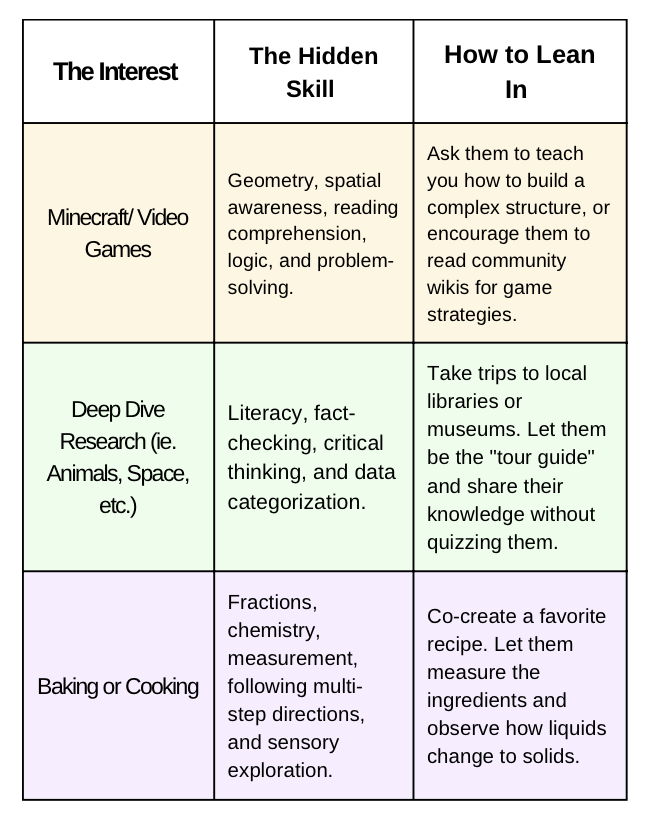
Shifting from Demand to Connection
As a community rooted in heart, integrity, and client-centered care, our goal at The NeuroKind Collective is always to prioritize the human being over the behavior.
This July, give yourself and your child permission to opt out of the neurotypical panic. Replace compliance with curiosity. When we honor a child’s natural inclination to explore the world on their own terms, we don't just protect their academic potential—we protect their mental health, their autonomy, and their joy.
A Note for the Caregiver: > Your child’s value is not measured by a test score on the first day of school in September. If your summer looks less like flashcards and more like blanket forts, deep-dives into specialized topics, and low-demand rest days, you are doing it beautifully.
Want more neurodiversity-affirming strategies for navigating the seasons? Check out our podcast episodes where we break down the individualizing of care, hot topics in ABA, and strategies for neuro-affirming care; or browse our NeuroKind apparel line—perfect for your next cozy, low-masking day at home.
